How to Polish Nano Engraved Pendants Safely

Last Updated: October 23, 2026
Quick Summary
Polish nano engraved pendants with a clean, dry microfiber cloth and light pressure, wiping in one direction and never across the text. Skip polishing compounds, rouge, and buffing wheels entirely, since these abrasives can permanently wear down the fine text. Photograph the engraving at magnification before and after each short pass to confirm legibility.
- The full polishing process takes about fifteen minutes and uses controlled hand-polishing, not scrubbing.
- Use a jeweler's loupe at 10x or your phone's macro mode to inspect the text before cleaning.
- Wipe in one direction, work from the center outward, and stop the moment the cloth feels like it is catching.
- Pat the pendant dry immediately with a lint-free cloth and never let it air-dry.
- Stop polishing as soon as the engraving looks duller than your baseline photo and see a jeweler.
Table of Contents
- Why Nano Engraved Pendants Need a Gentler Polishing Method
- What You'll Need Before You Start
- Step-by-Step: How to Polish Nano Engraved Pendants Without Damaging Text
- How to Clean Engraved Jewelry Around Text and Hard-to-Reach Areas
- Choosing a Jewelry Polishing Cloth for Engraved Pendants
- How to Remove Tarnish From an Engraved Pendant Without Lifting the Text
- How to Care for Laser Engraved Jewelry and Nano Engraving Long-Term
- When to Stop Polishing and See a Jeweler
- Frequently Asked Questions
Why Nano Engraved Pendants Need a Gentler Polishing Method
Nano engraved pendants hold their text on a microscopic chip at a scale far finer than traditional laser engraving, which changes how you should polish them. You can see an example of this type of engraving in the Rose Gold Nano Bible Disc Pendant Necklace.

That difference matters most during polishing: a cloth, brush, or compound that works on a plain silver pendant can dull or scratch a nano chip, and once the text loses clarity, no polish brings it back.
The core tension most guides miss: polishing removes tarnish, but it also removes material, and on a nano engraved pendant the margin for error is smaller than on any other piece of jewelry you own.
What You'll Need Before You Start
Gather gentle supplies before you touch the pendant. Every item here is soft, lint-free, or low-abrasion by design. Skip anything labeled abrasive, and skip anything you would not use on a camera lens.
- Mild dish soap, unscented and dye-free
- Lukewarm water in a small bowl
- A microfiber cloth, lint-free and clean
Skip these entirely: abrasive cleaners, polishing compound, rouge, buffing wheels, paper towels, and rough sponges. We cover why in the next section.
Step-by-Step: How to Polish Nano Engraved Pendants Without Damaging Text
The full process takes about fifteen minutes and uses controlled hand-polishing, not scrubbing. Work over a soft towel so a dropped pendant lands safely, and keep a magnifier within reach. Because the text sits at a scale that requires magnification to read, each pass must be short and checked.
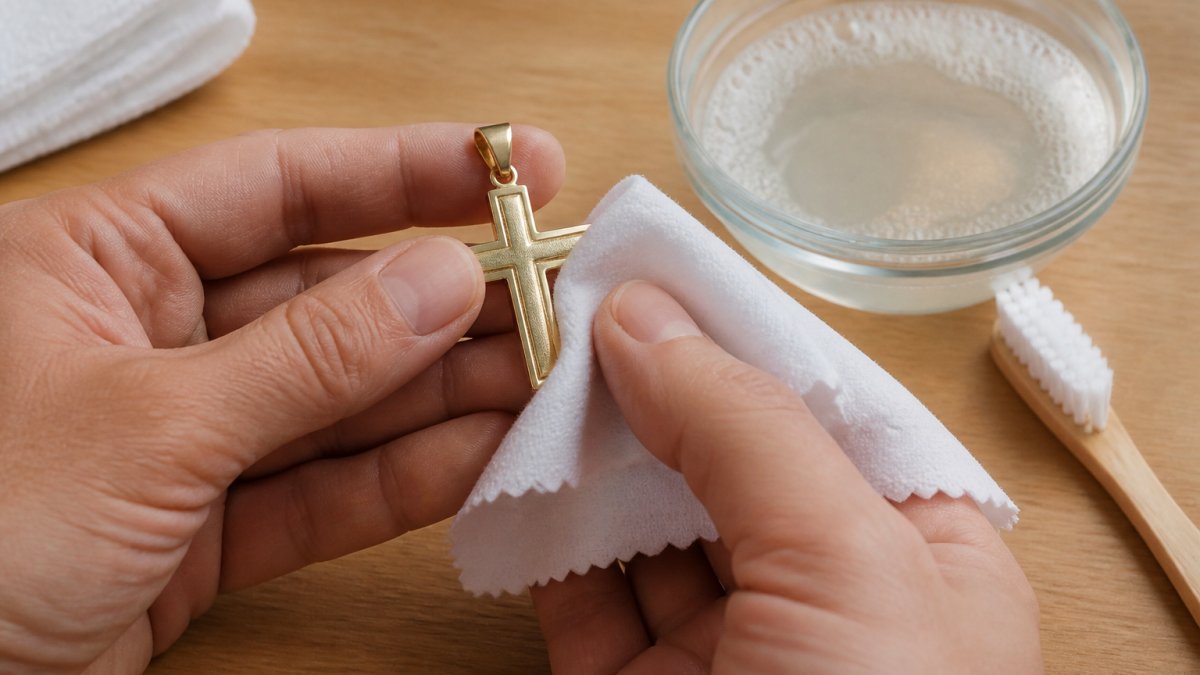
Step 1: Inspect, Magnify, and Photograph the Engraving
Photograph the engraving before you clean it: a sharp close-up with your phone in daylight, magnified on screen until the text fills the frame.
Use a jeweler's loupe (10x is standard) or your phone's macro mode to inspect the text for loose debris, oil film, tarnish spots, and existing scratches, and note where dirt collects around the bail, clasp, and pendant edge.
Step 2: Clean Loose Debris and Oils
Start with a dry pass: use the soft-bristled brush to lift loose dust, then wipe gently with a dry microfiber cloth. Dry cleaning removes most surface dirt without moisture reaching the engraving.
For oils and buildup, mix a drop of mild dish soap into lukewarm water. For more specific guidance, you can learn the best ways to clean delicate scripture necklaces at home.
Step 3: Polish With Controlled Pressure and Direction
This is where most damage happens. Use a clean, dry microfiber cloth and light pressure only, let the cloth do the work, not your hand.
- Wipe in one direction, not in circles, to avoid grinding debris into the surface.
- Keep pressure feather-light over the engraved area, think of the weight of a pencil eraser, not a fingertip press.
- Work from the center of the pendant outward, so you are not pushing debris across the text.
A useful rule for nano engraving: never polish across the text.
Never press hard to remove a stubborn spot. If a mark will not lift with light wiping, it needs a jeweler, not more force.
Step 4: Rinse, Dry, and Re-Inspect Legibility
Rinse quickly with clean lukewarm water, or wipe with a damp cloth if the piece should not get wet. Before you proceed, you can read this guide on whether nano engraving jewelry is waterproof. Pat dry immediately with a soft lint-free cloth.
Compare your new photo against the baseline at the same magnification, checking the engraved text for clarity, contrast, and sharpness.
Step 5: Decide Whether to Continue or Stop
After each short pass, make a deliberate stop-versus-proceed call rather than polishing until it looks better. Use this checklist:
- Proceed only if the text still matches your baseline photo at magnification and the cloth is lifting visible tarnish or soil.
- Stop if the text loses contrast, the edges of the characters look softer, or the cloth starts to feel gritty.
- Stop and see a jeweler if you see a lifting finish, a plated layer that looks worn, or scratches that were not in the baseline photo.
Write down how many passes you made and what you used, if you ever need to explain the piece's history to a jeweler, that record beats a memory of "I polished it a few times."
The full process takes about fifteen minutes, so here is each step at a glance.
| Step | What to do | Key detail |
|---|---|---|
| 1 | Inspect, magnify, and photograph the engraving | Phone close-up in daylight is your baseline |
| 2 | Clean loose debris and oils | Dry brush first, then a drop of mild dish soap |
| 3 | Polish with controlled pressure and direction | Light pressure, wipe in one direction, never across text |
| 4 | Rinse, dry, and re-inspect legibility | Pat dry immediately, never air-dry |
| 5 | Decide whether to continue or stop | Proceed only if text matches baseline photo |
How to Clean Engraved Jewelry Around Text and Hard-to-Reach Areas
Reach for a dry cotton swab before more soap.
For clasps and chain links, use the soft-bristled brush dry, then follow with a lint-free cloth. These spots collect skin oils and debris faster than the pendant face.
Rose Gold Nano Bible Disc Pendant Necklace →
A common mistake is digging at engraved text with a toothpick or pin. That tool can chip the surface finish and scratch the metal around the text.
Choosing a Jewelry Polishing Cloth for Engraved Pendants
A jewelry polishing cloth for engraved pendants should be soft, lint-free, and free of any built-in abrasive. Many cloths sold for silver carry a mild abrasive treatment on one side, exactly what you want to keep away from a nano chip.
Look for these qualities:
- 100% microfiber or tightly woven cotton
- No chemical treatment or polishing compound baked in
- Lint-free so fibers do not catch in the engraving
Wash your cloths regularly in plain water and air-dry them; a cloth carrying grit from another piece can scratch a pendant on the next wipe. Keep one cloth for cleaning and one for drying, and never mix them.
How to Remove Tarnish From an Engraved Pendant Without Lifting the Text
Tarnish removal is where nano engraved pendants need the most caution, and where generic advice fails: tarnish sits on the metal surface, and every method that removes it also touches the engraving.
The safe approach depends on the metal and finish, not just the tarnish. Use this as a starting framework:
- Sterling silver (92.5% silver): Tarnish is a surface layer and lifts with a dry microfiber cloth and light buffing. Silver dips and liquid removers can strip the finish and are too aggressive around fine text.
- Gold and gold-filled: Tarnish is less common; when it appears, a dry cloth and mild soapy water are usually enough. Avoid rouge and polishing compounds, which can wear the fine detail.
- Stainless steel: Generally tarnish-resistant. A damp cloth and mild soap handle most films; abrasive pads and polishing compounds are unnecessary and risky near the text.
Start with a dry microfiber cloth and light buffing. Many light tarnish films lift with nothing more than a soft cloth and a few minutes of gentle wiping.
Avoid these methods on nano engraved pieces:
- Silver dips and liquid tarnish removers, which can affect the finish and are hard to control around fine text.
- Polishing compound or rouge, which are abrasive by design.
- Buffing wheels and rotary tools, which generate heat and friction and can round the edges of characters.
If tarnish will not budge with a soft cloth, stop.
Photograph the pendant in the same light before and after every cleaning. Small changes in engraving clarity are easy to miss by eye but obvious in a side-by-side comparison.
How to Care for Laser Engraved Jewelry and Nano Engraving Long-Term
Long-term care comes down to three habits: keep it dry, store it soft, and clean it often with gentle tools. For a complete routine, read our guide on how to maintain nano engraved religious jewelry. Caring for laser engraved jewelry and nano engraving differs mainly in pressure and products, nano pieces need lighter handling, but both benefit from the same routine.
- Put jewelry on last, after lotion and perfume have dried
- Take pendants off before showering, swimming, or exercising
- Store each piece in its own soft pouch to prevent scratches, and see our detailed tips on how to store nano engraved Bible jewelry to prevent scratches
Our rose gold pieces, like the Rose Gold Nano Bible Disc Pendant Necklace, use a stainless steel base with a tarnish-resistant finish, which helps slow surface changes. That finish still deserves gentle handling.
When to Stop Polishing and See a Jeweler
Stop polishing the moment the engraving looks duller than your baseline photo, the clearest sign the surface is changing, and more polishing will only make it worse. Set the cloth down and get a professional opinion.
See a jeweler if you notice any of these:
- Text that has lost contrast or sharpness
- Deep scratches across the pendant face
- A plating or finish that looks worn or lifted
A jeweler can inspect the piece under magnification and tell you whether professional polishing is safe. Ask them to work around the engraving rather than over it, and for rhodium-plated or plated finishes, ask whether polishing would remove the plating before you agree to any work.
The safest polish is the lightest one. A soft cloth, mild soap, and light pressure handle most cleaning. Anything abrasive risks the text permanently.
Caring for a nano engraved pendant takes a little patience, but the routine is short and the payoff is a piece that stays legible for years. Explore our Gold Nano Bible Cross Pendant Necklace and the rest of our faith-inspired collection, backed by free shipping, secure payment, and responsive customer support.

Frequently Asked Questions
Can you polish a nano-engraved pendant without damaging the text?
Yes, if you avoid abrasives and keep pressure light. Nano engravings sit on a very fine scale, so the risk comes from polishing compounds, rough cloths, and hard scrubbing rather than from polishing itself. Use a clean microfiber cloth, a drop of mild dish soap in lukewarm water, and short, gentle strokes. Skip rouge, buffing wheels, and anything labeled abrasive. Inspect the text under bright light before and after each session so you can catch any change in legibility early.
How do you clean engraved jewelry around text and hard-to-reach areas?
Work a soft-bristled brush or a cotton swab into the recessed areas around the engraved text with light circular motions, then rinse under lukewarm running water. Pat dry with a lint-free cloth and let it air dry fully before wearing. Avoid toothpicks, pins, or anything sharp that could catch an edge of the engraving.
What products should you avoid on nano-engraved jewelry?
Avoid abrasive cleaners, polishing compounds such as rouge, buffing wheels, ultrasonic cleaners, and any cloth with grit or scrub texture. Skip chlorine, bleach, ammonia, and acetone, which can dull plated finishes and attack the surface around fine text. Do not use toothpaste, baking soda paste, or vinegar soaks on a nano-engraved pendant. For tarnish, a dry polishing cloth made for jewelry is the safer choice than a liquid dip, and it should be used lightly over the metal, not scrubbed into the text.
What should you do if the engraving looks faded after polishing?
Stop polishing immediately and inspect under bright, angled light. Sometimes what looks like fading is residue from polish or soap trapped in the recessed text, which a lukewarm water rinse and a soft brush will clear. If the text still reads poorly after drying, do not polish again. Take the pendant to a jeweler who can examine the surface under magnification and tell you whether the engraving has been worn or whether a finish layer needs attention. Continued polishing at that point risks making it worse.
