How to Store Nano Engraved Bible Jewelry to Prevent Scratches

Table of Contents
- Why Nano Engraved Bible Jewelry Needs Different Care
- Preventing Scratches on Fine Jewelry: The Basics That Protect the Chip
- Best Jewelry Storage for Delicate Necklaces and Bracelets
- How to Clean Nano Engraved Jewelry Without Damaging the Engraving
- Travel Storage: Keeping Your Nano Chip Safe on the Go
- Humidity, Temperature, and Long-Term Oxidation Protection
- Daily Wear Habits That Extend Jewelry Longevity
- Conclusion
- Frequently Asked Questions
Last Updated: September 16, 2026
Why Nano Engraved Bible Jewelry Needs Different Care
Nano engraved Bible jewelry holds the complete King James Version of Scripture on a chip smaller than a grain of rice, and that microscopic text is more vulnerable to friction than the metal around it, which is why knowing how to store nano engraved bible jewelry to prevent scratches matters from day one. Learning how to store nano engraved bible jewelry to prevent scratches protects both the finish and the engraving. At LodMud, we treat the nano chip as a delicate technological component, not just a decorative inlay, because the etching depth is measured in microns.
This is where most care advice falls short. Standard jewelry guides tell you to toss a pendant in a box and call it done. That works for a plain gold band. It does not work for micro-engraving, where a single deep scratch across the chip can obscure lines of text that took precision equipment to write.
The good news: the fix is simple and cheap. Below, we'll show you exactly how to store, clean, and wear these pieces so the engraving stays legible for years.
Preventing Scratches on Fine Jewelry: The Basics That Protect the Chip
Preventing scratches on fine jewelry starts with one rule: metal never touches the nano chip. The chip sits in a recessed setting, and anything harder than that setting, including another piece of jewelry, can grind against it during movement.
Three habits do most of the work:
- Store pieces individually. One pouch per item. A chain draped over a pendant will abrade the surface within weeks.
- Remove jewelry before physical tasks. Keys, gym equipment, and countertops are all harder than gold plating.
- Fasten clasps before storage. An open spring-ring clasp is a hook that scratches whatever it touches.
What most guides miss is that the stone halo around a chip can also cause damage.
Best Jewelry Storage for Delicate Necklaces and Bracelets
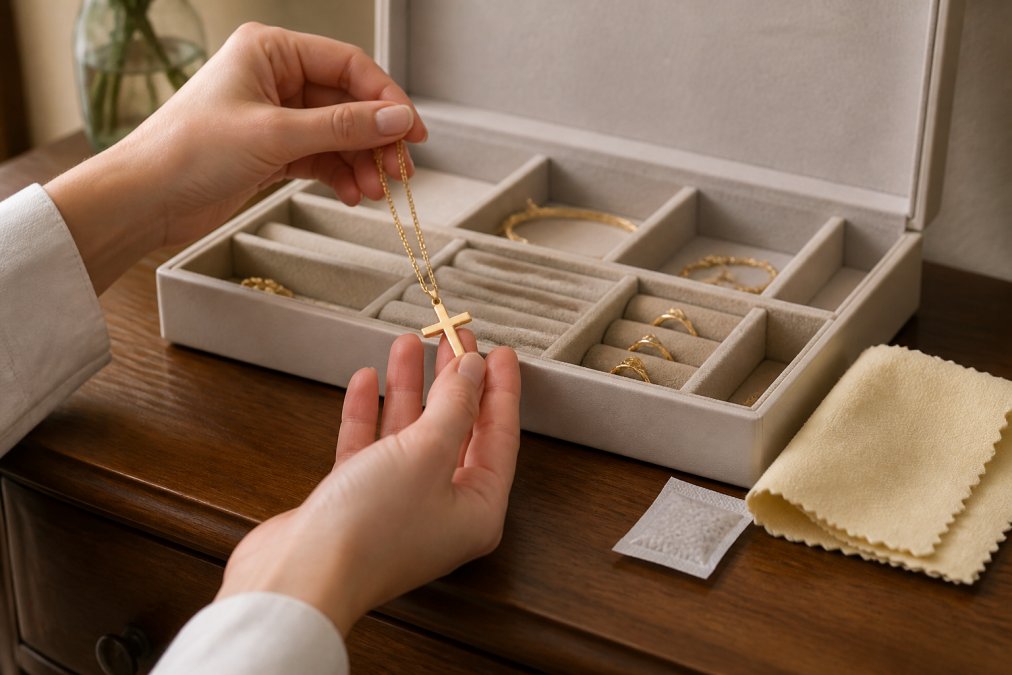
The best jewelry storage for delicate necklaces and bracelets is a microfiber-lined or velvet-lined jewelry box with individual compartments, kept closed and away from direct light. Fabric lining cushions movement; compartments stop pieces from colliding. An airtight container with a silica gel packet adds moisture control on top of that.
Why Fabric Choice Matters More Than Box Style
Most guides stop at "use a lined box." That advice is incomplete for a nano-engraved chip, because the fabric itself can abrade the engraving. The relevant mechanism is micro-abrasion: when two surfaces slide against each other under light pressure, the softer one loses material at a microscopic scale. A nano chip's etched grooves are only microns deep, so even a fabric that feels soft to your fingertips can polish away legibility over months of vibration.
- Velvet (silk or cotton pile): The pile collapses under pressure and lets the chip sit in a low-contact pocket. Best for long-term storage.
- Anti-tarnish microfiber: Tight weave, low lint, and often treated with a corrosion inhibitor. Good for pouches and travel wraps, but replace once the weave pills.
- Felt and wool blends: Fibers are coarse at the microscopic level and shed. Avoid direct contact with the chip face.
- Cotton muslin or paper tissue: No cushioning and high lint. Fine as an outer wrap, never as the contact layer.
- Foam inserts (original packaging): Safe short-term, but many foams degrade and crumble within a few years, releasing grit against the chip.
Materials That Protect Surface Integrity
Material choice decides whether your storage protects surface integrity or quietly erodes it. Ranked from best to worst:
| Storage Material | Protection Level | Best For | Watch Out For |
|---|---|---|---|
| Velvet-lined compartment box | Highest | Pendants, rings, bracelets | Must stay dry |
| Anti-tarnish microfiber pouch | High | Travel, single pieces | Replace when worn thin or pilled |
| Airtight container + silica gel | High (moisture) | Long-term storage | Open monthly to air out |
| Original packaging | Moderate | Short-term, shipping | Foam degrades and sheds grit over time |
| Open dish or tray | Lowest | Nothing delicate | Guarantees scratches |
How to Clean Nano Engraved Jewelry Without Damaging the Engraving
To clean nano engraved jewelry, use lukewarm water, a drop of mild dish soap, and a soft microfiber polishing cloth. Never use ultrasonic cleaners, steam cleaners, or abrasive polishes on a nano chip. Those methods are designed for solid metal and will attack a micro-engraved surface.
Follow these steps:
- Fill a small bowl with lukewarm water and one drop of mild soap.
- Soak the piece for two to three minutes to loosen body oils.
- Wipe gently with a microfiber cloth, moving with the grain of the metal.
- Rinse under lukewarm running water, keeping the chip face down.
- Pat dry completely before returning it to storage.
Travel Storage: Keeping Your Nano Chip Safe on the Go
Travel is where most jewelry damage happens, because bags get compressed and pieces get jostled for hours. The fix is a hard-shell case with foam or fabric dividers, not a zippered pouch tossed in a carry-on.
Cross Bracelet with Bible chip →
Pack like this:
- Wear or carry your most delicate piece rather than checking it.
- Use a protective-pouch inside a rigid case for each item.
- Keep a silica gel packet in the case to handle humidity swings.
- Never pack jewelry loose with keys, chargers, or shoes.
Humidity, Temperature, and Long-Term Oxidation Protection
Humidity above roughly 60 percent accelerates tarnish on plated metals, and rapid temperature swings cause condensation inside closed boxes. Both problems are manageable with the same tool: a sealed container and a moisture absorber.
Working Thresholds for a Nano-Engraved Piece
Most jewelry care pages say "keep it dry" and stop there. For a nano chip, a few working ranges are more useful than a slogan:
- Relative humidity: Aim for 40 to 50 percent. Below 30 percent, some adhesives and plated finishes can dry and micro-crack; above 60 percent, tarnish reactions accelerate noticeably.
- Temperature: Keep storage between roughly 60°F and 75°F. The concern is not the absolute number but the swing, repeated cycles of warm and cool drive condensation on metal surfaces.
- Rate of change: A piece moved from a cold car into a warm room can fog within minutes. Let the closed case come to room temperature before opening it.
Oxidation and Scratching Are Different Problems
This is the clarity gap most guides miss. Oxidation and scratching are different threats with different fixes, and treating them as one problem leads to the wrong storage setup.
| Threat | Cause | What Actually Fixes It |
|---|---|---|
| Scratches / micro-abrasion | Physical contact and vibration | Separation: one pouch or slot per piece |
| Tarnish / oxidation | Air, moisture, sulfur compounds | Sealing: airtight container plus absorber |
| Condensation haze | Temperature swings | Stable storage location, gradual warming |
| Chemical etching | Perfume, chlorine, sunscreen | Removal before exposure |
Scratches come from contact, so separation solves them. Tarnish comes from air and moisture, so sealing solves it. Build for both and the nano engraving stays legible.
Daily Wear Habits That Extend Jewelry Longevity
Daily wear care comes down to timing: put jewelry on last and take it off first. Perfume, hairspray, sunscreen, and lotion all contain chemical-exposure risks for plated finishes, and applying them over a piece traps residue against the metal.
Build these habits into your routine:
- Remove jewelry before showering, swimming, and exercising.
- Apply cosmetics and fragrance before putting the piece on.
- Wipe the piece with a dry cloth at the end of the day.
- Check the clasp and setting monthly for looseness.
Conclusion
The challenge with nano-engraved jewelry is that the most valuable part, the chip, is also the most fragile, and standard jewelry advice ignores that entirely. LodMud builds pieces like the Gold Nano Bible Cross Pendant Necklace with Figaro Chain Large with tarnish-resistant stainless steel, a scratch-resistant finish, and a nano chip that holds the complete King James Version, so the piece is made to be worn rather than locked away.

Frequently Asked Questions
Can nano-engraved jewelry be stored with other metal pieces?
Store nano engraved jewelry separately from other metal pieces. Even gold and silver chains can create friction that scratches the chip's protective casing over time. Use a velvet-lined or microfiber-lined compartment, or place each piece in its own protective pouch. If you must store items together, wrap the nano piece in a soft polishing cloth first. This simple separation prevents the micro-abrasion that dulls engraving durability and keeps your Bible chip readable for years.
Does humidity affect the longevity of nano-engraved Bible jewelry?
Yes. High humidity accelerates oxidation and moisture exposure, which can cloud the chip's surface and weaken the bond between the engraving and its casing. Keep storage areas below 60% relative humidity. Add a silica gel packet to your jewelry box and replace it every two to three months. Avoid storing pieces in bathrooms where steam from showers raises moisture levels. An airtight container with a corrosion inhibitor offers the strongest protection for long-term storage.
How do I clean nano-engraved jewelry without damaging the engraving?
Use a dry or barely damp microfiber polishing cloth. Wipe the metal gently, then use a separate dry corner to buff the chip area. This method removes body oils and surface grime without risking the delicate components inside the chip.
Should I store my jewelry in its original packaging or a jewelry box?
Original packaging works well for short-term storage because it is sized to the piece and often microfiber-lined. For daily use, a dedicated jewelry box with individual velvet-lined compartments gives better protection and easier access. Whichever you choose, keep the piece away from direct sunlight, heat sources, and loose metal objects. If you travel, use the original protective pouch inside a hard-shell case to prevent crushing and friction during transit.