How to Verify Microscopic Bible Engraving Quality

Table of Contents
- What Nano Engraving Technology Actually Is
- How to View Nano-Engraved Scripture Under Magnification
- Durability of Microscopic Bible Chips: What to Check
- Technical Specifications That Separate Quality Engravings
- Counterfeit Detection: Spotting Fake Microscopic Bible Engravings
- Scientific Standards for Micro-Engraving Quality
- Frequently Asked Questions
Last Updated: September 26, 2026
What Nano Engraving Technology Actually Is
Nano engraving is the practice of etching text or images at a microscopic scale onto a tiny chip, often smaller than a grain of rice. This technology lets a full passage of scripture sit inside a piece of jewelry you can wear every day. This guide from LodMud walks through how to verify the quality of microscopic bible engravings, step by step, so you know exactly what you're buying.
The core idea is simple. A focused beam carves characters so small that a standard magnifying glass won't reveal them. You need real magnification to read anything at all.
Nano-engraved scripture is a passage of Biblical text etched onto a microchip at a scale measured in microns, designed to be worn as a personal reminder of faith.
How Microscopic Text Gets Etched Onto a Chip
The process starts with a substrate material, usually a silicon wafer or a polished metal surface. A laser or electron beam then etches characters into that surface, one tiny line at a time.
Two things decide quality here:
- Laser precision and beam width, which control how sharp each character is
- Engraving depth, which affects how well the text survives wear over time
A shallow etch looks fine on day one. It fades with friction. A deeper etch holds its legibility for years.
How to View Nano-Engraved Scripture Under Magnification
To view nano-engraved scripture, you need a magnification tool rated at least 30x, though 60x to 100x gives a much clearer read. Standard reading glasses won't work. The characters are simply too small. Most consumer-grade nano Bible chips are etched with character heights in the 50-200 micron range, which is roughly the width of a human hair or smaller.
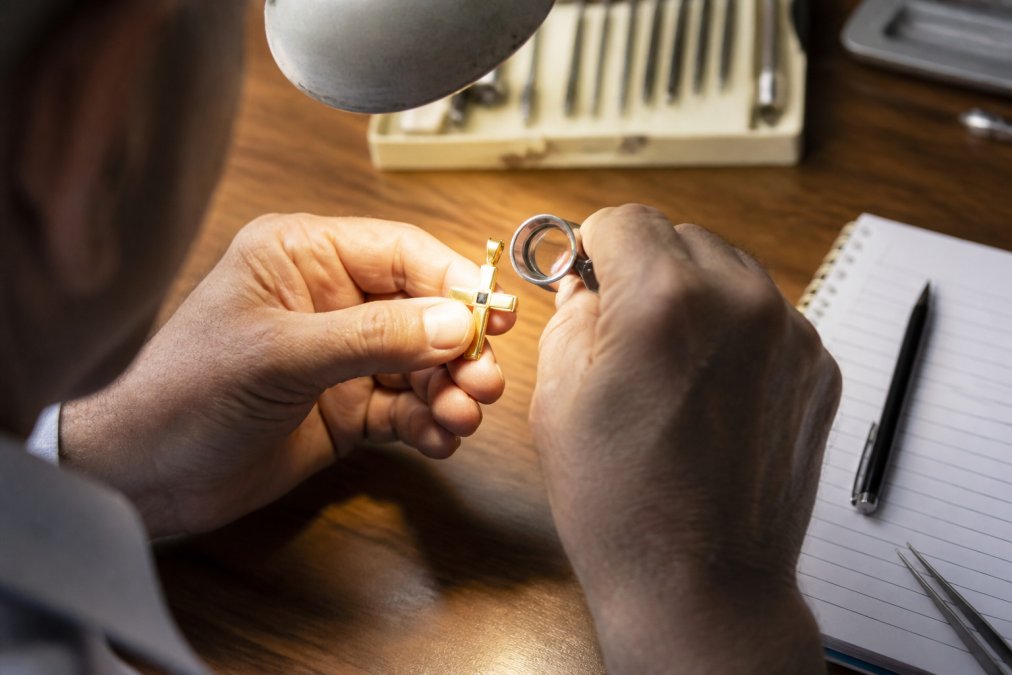
- 10x jeweler's loupe, locate the chip, confirm it exists, and check that it sits flush in its setting. You will not read text at this power.
- 30x-40x loupe or macro lens, see that characters exist as distinct marks. Edges will look soft. Good enough to confirm the chip is engraved, not printed.
- 60x-100x optical microscope or digital microscope, read the passage. This is the minimum power for verifying that the verse matches what you ordered.
- 200x-400x digital microscope, inspect character edges, engraving depth, and surface finish. This is where you separate a careful etch from a rushed one.
Lighting and Setup That Actually Work
Lighting matters more than people expect. Angled light catches the etched grooves and makes characters readable. Flat overhead light washes them out completely.
A setup that works for most home verification:
- Use a single-point LED or a small adjustable desk lamp, not a broad ceiling fixture.
- Position the light at roughly 30 to 45 degrees to the chip surface, not straight down.
- Hold the loupe or microscope steady against a fixed surface, hand shake is the number one reason people think a chip is blank.
- Work on a matte dark background so the chip's edges and any raised print layer stand out.
- Start at low power to find the chip, then step up. Jumping straight to 100x makes the chip hard to locate.
DIY Verification Techniques You Can Try at Home
- Use a 30x or higher loupe or macro lens to confirm text exists at all
- Tilt the chip under a lamp to see if characters catch light evenly
- Check that letters are sharp, not smeared or doubled
- Confirm the chip sits flush and doesn't wobble in its setting
- Compare the visible text against the verse you actually ordered
- Photograph the chip through your lens at 60x or higher, a photo freezes the image and lets you zoom in further on a screen
- Repeat the check under two different light angles; a genuine etch reads clearly from both, a printed layer often only reads from one
If you cannot read the passage at 60x with angled light, ask the seller for their stated magnification rating and depth specs before buying. A seller who cannot name those numbers is a seller who cannot verify their own product.
Durability of Microscopic Bible Chips: What to Check
Durability of microscopic bible chips comes down to three factors: engraving depth, substrate material, and surface protection. A chip with all three done well can handle daily wear, including showers and light exercise.
Ask or check for these:
- Corrosion resistance on metal substrates, since skin oils and moisture cause breakdown over time
- Electroplated or e-coated finishes, which shield the chip from friction
- A polished surface that resists scratching around the etched area
Technical Specifications That Separate Quality Engravings
Character density and resolution are the two specs that matter most. Higher character density means more text fits in the same space. Higher resolution means each character stays readable at that density. But those two numbers only mean something once you know how the chip was made.
Laser Ablation vs. Photolithography
Most nano-engraved Bible chips on the market are produced one of two ways:
- Laser ablation, a focused laser beam removes material from a silicon wafer or metal substrate, cutting each character directly. It is fast and works on curved or irregular surfaces, which suits jewelry. The trade-off is that beam width limits how small characters can go, and heat-affected zones can leave slightly rough edges if the power settings are wrong.
- Photolithography, a light-sensitive mask is used to transfer a pattern onto the substrate, then chemical etching removes the exposed material. It produces sharper, more uniform characters at smaller sizes than laser ablation, which is why it is the standard for semiconductor fabrication. The trade-off is that it requires flat surfaces and clean-room conditions, so it is less common for finished jewelry pieces.
Benchmarks Worth Asking For
Look for these markers of a well-made chip:
- Legibility that holds up at 60x, not just 30x
- Consistent engraving depth across the whole passage, typically a few microns for a durable etch
- A surface finish free of burrs or uneven patches
- A substrate material suited to the jewelry's metal type, silicon wafers for chips, or direct etching on the metal itself
- A stated character height in microns, not a vague "microscopic" claim
For a sense of how precision manufacturing standards are set, the National Institute of Standards and Technology publishes reference material on micro-scale measurement that informs how these tolerances are judged.
Counterfeit Detection: Spotting Fake Microscopic Bible Engravings
Fake microscopic bible engravings usually fail on one of three points: the text is printed rather than etched, the characters blur under magnification, or the chip has no unique identifiers tying it to a specific order.
Here's how to tell the difference:
| What to Check | Genuine Engraving | Common Fake |
|---|---|---|
| Text under 60x | Sharp, even characters | Blurry or smeared |
| Surface feel | Smooth, flush etch | Raised print layer |
| Unique identifier | Present on chip or certificate | Missing or generic |
| Depth | Consistent across passage | Uneven or shallow |
Scientific Standards for Micro-Engraving Quality
There's no single universal standard for micro-engraving in jewelry, but several measurement principles apply across the field. Resolution, character density, and engraving depth are all measured against established optical benchmarks.
Frequently Asked Questions
How is the entire Bible engraved on a microscopic chip?
Nano engraving uses a focused beam to etch characters at scales measured in nanometers, roughly one-billionth of a meter. At that resolution, text becomes so small that an entire Bible can fit on a chip smaller than a fingernail. The process relies on laser precision and a stable substrate material, typically silicon or a treated metal wafer, to hold each character without blurring or overlap. Character density and engraving depth are the two variables that determine whether the text stays legible.
Are nano-engraved Bible verses visible to the naked eye?
No. The engraved text on a microscopic Bible chip is far too small to read without magnification. To the naked eye, the chip looks like a solid black or dark surface. Under an optical microscope at 100x to 400x magnification, individual characters become visible. This is why how to view nano-engraved scripture always starts with the right magnification tool. A jeweler's loupe at 10x will show the chip's surface finish but not the text itself.
How durable are microscopic Bible engravings on jewelry?
Durability depends on three factors: engraving depth, substrate material, and surface protection. Chips engraved into silicon or metal wafers with adequate depth resist fading far better than shallow surface marks. A protective coating, such as the e-coating used on gold-plated pieces, shields the chip from moisture and friction. For everyday wear, including showering and light exercise, a well-made chip should hold its legibility for years. Deep micro-etching and corrosion-resistant materials are the benchmarks to look for.
How can I tell if a microscopic engraving is authentic?
Start with visual inspection under magnification. Authentic micro-etching shows consistent character density, clean edges, and uniform engraving depth. Blurry or uneven text suggests low laser precision or a counterfeit. Ask for a certificate of authenticity that documents the substrate material and magnification power used during production. Reputable sellers also provide high-resolution photographs of the actual engraving. If a seller cannot show you the text under an optical microscope, treat the authenticity claim with caution.
Verifying a microscopic bible engraving takes ten minutes and a loupe, but it protects you from a piece that fades or fails within months. At LodMud, we build each Nano Faith chip with a real engraved surface, protective e-coating, and a design made to be worn daily, not stored away. Browse the Nano Faith collection and find a piece that keeps scripture close, wherever the day takes you.