Why Nano Engraved Jewelry Is Expensive

Table of Contents
- What Makes Nano Engraved Jewelry Expensive
- The Precision Engineering Behind Nano Engraving
- Nano Engraving vs Laser Engraving: Why the Cost Difference Matters
- Material Science and Premium Craftsmanship
- Nano Engraved Bible Verse Jewelry Durability and Longevity
- Is Nano Bible Jewelry Waterproof and Built to Last
- The Hidden Costs of Custom Production and Quality Assurance
- Frequently Asked Questions
Last Updated: August 31, 2026
What Makes Nano Engraved Jewelry Expensive
Nano engraved jewelry commands premium prices due to manufacturing processes operating at scales invisible to the human eye. The cost reflects equipment, expertise, and quality control required at every stage. A single nano-engraved pendant involves laser systems calibrated to tolerances measured in micrometers, clean-room production environments, and verification processes that ensure microscopic text remains legible, durable, and permanent across decades of daily wear.

The Precision Engineering Behind Nano Engraving
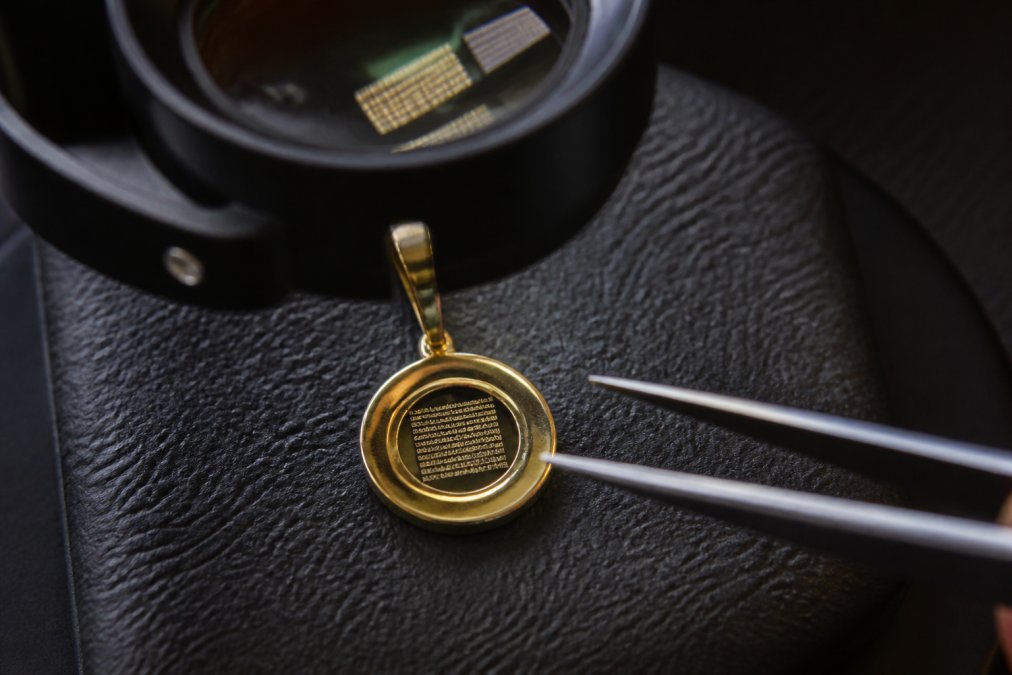
Nano engraving uses fiber laser technology to etch text onto a microscopic chip at resolutions requiring laser beam diameters measured in microns. A fiber laser system capable of nano-scale engraving costs tens of thousands of dollars and must maintain consistent power output, precise focal length, and stable temperature conditions (peer-reviewed research). Any drift in these parameters results in illegible text or material damage.
Engraving depth is critical for durability. Shallow engraving risks fading over years of wear, while deeper engraving increases fracture risk in delicate metals. Engineers calculate optimal depth for each metal type, considering hardness, thermal conductivity, and material response to rapid laser heating and cooling.
Setup and calibration for each production run consumes 2-4 hours. The laser must be aligned, test-engraved on sample materials, and verified under microscope inspection before customer pieces enter the system. This overhead cost gets distributed across production batches; smaller batches mean higher per-unit cost.
Quality assurance requires optical inspection equipment. Each finished piece is examined under magnification to verify legibility and ensure specifications are met. A single flaw discovered after shipping creates liability, replacement costs, and reputation damage.
Nano Engraving vs Laser Engraving: Why the Cost Difference Matters
Standard laser engraving produces visible marks 0.5-2mm deep using CO2 or fiber lasers with beam diameters of 100-500 micrometers (peer-reviewed research). It's fast, scalable, and inexpensive. Nano engraving operates at a completely different scale, producing text requiring magnification to read, using fiber lasers with beam diameters under 20 micrometers (peer-reviewed research). The process tolerates almost no variation in power, focus, or material preparation.
A single laser engraver can process hundreds of pieces per day. A nano engraver might complete 10-20 pieces daily. The nano-chip substrate costs more than traditional engraving materials because it's manufactured to semiconductor-grade standards in clean-room facilities. If 90% of produced chips pass quality inspection, that 10% failure rate gets absorbed into the price of successful units.
Setup costs differ dramatically. Nano engraving requires laser calibration, test engraving, microscopic inspection, and material testing before production begins. For small custom orders, setup costs can exceed per-unit material cost. Standard laser engraving requires basic setup and proceeds immediately to production.
Why nano engraved jewelry is expensive becomes clearer when considering speed and customization. A nano engraver produces limited quantities with exceptional precision. When you request a custom Bible verse on a nano chip, you're paying for setup time that won't be distributed across hundreds of units.
Material Science and Premium Craftsmanship
Jewelry-grade stainless steel (typically 316L) dominates nano engraved jewelry because it resists corrosion, maintains structural integrity under laser engraving's thermal stress, and offers excellent longevity. The material must respond predictably to laser engraving; some alloys scatter the beam or absorb heat unevenly, producing inconsistent results.
Gold-plated and gold ion-plated finishes require precise electroplating or ion-plating equipment. A 0.5-micron gold coating must be uniform and thick enough to resist wear without creating uneven surfaces that interfere with engraving precision. The plating process introduces cost in both equipment and waste management.
Cubic zirconia and crystal accents add aesthetic value but manufacturing complexity. Each stone must be set precisely, introducing risk of cracking or dislodging if mounting isn't executed perfectly. Quality assurance means inspecting every stone setting.
The nano-chip itself represents the largest material cost. These chips are manufactured to semiconductor-grade specifications with exact material composition, thickness tolerance (often ±0.1mm), and surface finish. A chip that's slightly too thick won't fit inside jewelry without visible bulging; one too thin risks fracture.
Premium craftsmanship includes redundancy in quality control with multiple inspection points ensuring finished pieces meet standards and preventing defective pieces from reaching customers.
Nano Engraved Bible Verse Jewelry Durability and Longevity
Engraving depth is the primary durability factor. Nano-scale engraving typically creates marks 5-15 micrometers deep, providing protection against surface wear while maintaining material integrity. Marks deeper than 15 micrometers risk creating stress concentration points that could lead to cracking.
Stainless steel, with a Vickers hardness around 200-300, resists scratching and surface degradation far better than softer metals. Gold-plated stainless combines steel's durability with gold's aesthetic appeal.
Testing protocols typically simulate years of wear through accelerated mechanical stress, moisture exposure, and temperature cycling. Well-designed nano-engraved pieces show minimal legibility loss after equivalent to 10+ years of daily wear.
Nano engraving doesn't fade like traditional surface engraving. It creates a permanent modification to material structure itself. Even if the surface wears slightly, the engraved text remains visible because the mark extends into the material.
Is Nano Bible Jewelry Waterproof and Built to Last
The nano-chip itself is inherently waterproof and inert. Stainless steel resists water exposure far better than silver or uncoated gold, withstanding daily shower exposure, chlorinated pool water, and saltwater without significant degradation.
Gold ion-plating adds a protective layer resisting tarnishing from moisture exposure. A well-executed 0.5-micron gold coating on stainless steel maintains appearance through years of water exposure, though it gradually wears from friction and contact with soaps and lotions. The underlying stainless steel remains durable and corrosion-resistant.
Crystal and cubic zirconia accents require careful consideration. Premium jewelry uses epoxy adhesives formulated for water resistance, ensuring durability and adding cost.
Connections between components matter significantly. Many modern nano engraved pieces use mechanical settings and friction fits rather than solder, eliminating potential failure points.
Real-world durability data from customers wearing pieces daily in showers, during swimming, and in sweaty conditions report minimal degradation.
The Hidden Costs of Custom Production and Quality Assurance
Custom nano engraving introduces costs not present in standard designs. When requesting a specific Bible verse on a nano chip, setup includes design verification, engraving software programming, and test-engraving on sample material, a process taking 1-2 hours requiring skilled technicians.
Material waste increases with custom production. Standard designs are optimized after hundreds of test runs. Custom orders require test samples consuming material; a typical custom order generates 3-5 test pieces before final approval.
Quality assurance for custom pieces is more rigorous than standard production. Each custom piece is inspected individually under magnification to verify correct text engraving, proper spacing, and absence of material damage. Standard pieces can be inspected in batches.
Verification and documentation add cost. Many customers request photos confirming their specific Bible verse was engraved correctly before shipping, requiring photography, file organization, and additional quality control steps.
For large orders, the nano-chip itself might be custom-manufactured. Commissioning pre-engraved nano-chips reduces per-unit cost but requires minimum order quantities and advance payment. Smaller orders have blank chips engraved during final production, costing more per unit.
Liability considerations factor into pricing. Custom pieces with specific Bible verses carry higher perceived value and emotional significance. Manufacturers price custom work with this in mind, often including additional quality control steps and faster replacement policies.
The Cross Pendant Imperial Pave with Bible Chip represents semi-custom production with standard designs but premium materials. The pave setting requires precise stone placement, and the black diamond-shaped Bible chip adds distinctive styling, balancing craftsmanship with reasonable production costs at $109.00.

Nano engraved jewelry represents a genuine intersection of faith and technology. The expense reflects real manufacturing complexity, material science, and precision engineering ensuring your piece remains legible and beautiful for decades. Understanding why nano engraved jewelry is expensive transforms the price from seeming arbitrary to clearly justified.
At LodMud, we've built Nano Faith around this technology because faith deserves durability. When you wear a piece with your favorite Bible verse engraved at nano-scale, you're carrying scripture that will outlast you. That permanence matters. Explore pieces like the Rose Gold Nano Bible Disc Pendant Necklace ($90.00) or the Gold Nano Bible Heart Pendant Necklace with Crystals ($95.00) to experience the craftsmanship firsthand. Each piece combines precision engineering with meaningful design, delivering jewelry that honors both your faith and your commitment to quality.


Frequently Asked Questions
Q: Can the entire Bible really fit on a nano-engraved chip?
A: Yes. The complete King James Version of the Bible is engraved onto a microscopic nano chip using fiber laser technology and nanoscale precision. The text is readable only under magnification, but the entire scripture is genuinely present. This miniaturization is what makes nano-engraved jewelry so remarkable, and so expensive to produce. The technology required to achieve this level of detail at such a small scale demands clean-room manufacturing and semiconductor-grade precision engineering.
Q: Is nano engraved bible verse jewelry durable enough for daily wear?
A: Nano-engraved jewelry is built for daily wear when crafted with proper materials and quality assurance protocols. The engraving depth and surface integrity are preserved through premium stainless steel construction, protective coatings, and wear-resistant finishes. Durability depends on the manufacturer's standards. LodMud pieces use tarnish-resistant materials and scratch-resistant finishes specifically designed to withstand constant use, including exposure to water and exercise. The nano chip itself is protected within the pendant structure, making it highly resistant to fading or degradation.
Q: How does nano-engraving technology work on jewelry?
A: Nano-engraving uses a fiber laser with an extremely fine beam diameter to etch text and images onto a microscopic chip at nanoscale layers. The laser creates precise, high-resolution marks without damaging the material's structural integrity. This precision engineering requires clean-room manufacturing environments and advanced quality assurance processes to ensure optical clarity and legibility under magnification. The process is far more complex than traditional laser engraving, which is why it commands a premium price and delivers superior longevity.
Q: What makes nano-engraved jewelry cost more than other religious jewelry options?
A: Nano-engraved jewelry is expensive because of four key factors: the advanced fiber laser technology and clean-room manufacturing required, the premium materials used (stainless steel, gold plating, genuine crystals), the custom production process for each piece, and the extensive quality assurance needed to verify the engraving's clarity and durability. Unlike mass-produced alternatives, bespoke nano-engraved pieces require precision engineering at every stage. The cost reflects both the technology's sophistication and the craftsmanship required to deliver a product that lasts a lifetime.
This article was written using GrandRanker