Quality of Custom Engraved Jewelry: 2026 Review

Table of Contents
- How to Tell if Engraved Jewelry Is High Quality
- Laser Engraving vs Hand Engraving Quality: What Actually Lasts
- Best Metals for Custom Engraved Jewelry
- Nano Engraved Bible Verse Jewelry Durability Under Daily Wear
- What Custom Engraved Jewelry Actually Costs
- Durability, Wear-Over-Time, and Ethical Sourcing
- Conclusion
- Frequently Asked Questions
Last Updated: September 13, 2026
How to Tell if Engraved Jewelry Is High Quality
The quality of custom engraved jewelry comes down to three measurable things: engraving depth, metal purity, and finish consistency. This guide breaks down what actually separates a piece that lasts from one that fades.
Depth is the first test. Run a fingernail across the engraving. If you can feel a distinct groove, the mark was cut into the metal rather than burned onto the surface. Shallow marks look sharp on day one and blur within a year of daily wear.
The second test is metal. Solid 316L stainless steel, sterling silver, and gold-filled stock hold detail far better than plated brass or zinc alloy. Jewelers of America guidance on precious metal standards outlines how metal purity and plating thickness are classified, which matters because a thick plating is the only thing standing between a brass core and your skin.
Laser Engraving vs Hand Engraving Quality: What Actually Lasts
Laser engraving and hand engraving both last decades when done properly, but they fail in different ways. Hand engraving cuts a V-shaped groove with a graver, removing metal and leaving crisp walls that survive polishing. Laser engraving vaporizes a shallow layer, which is faster and cheaper but far more dependent on the operator's power settings.
Engraving Depth and Font Legibility Over Time
Depth drives legibility. A hand-cut groove typically runs deeper than a laser pass, so it keeps its edges through years of contact with skin, desks, and fabric. Laser work can match that depth, but most mass-produced pieces run the laser fast to save time, and shallow burns fill with skin oils and oxidation until the text reads as a smudge. Font choice compounds this: thin scripts and hairline serifs lose their crossbars first, while block and serif fonts with thicker strokes stay readable. If you want a verse or a date to still be legible in ten years, choose a heavier font and ask the maker what depth they cut to.
Best Metals for Custom Engraved Jewelry
Solid 316L stainless steel is the best all-round metal for engraved pieces worn daily, followed by sterling silver for dress wear and gold-filled stock for warmth of color. Each holds engraving differently, and the trade-offs matter more than the price tag.
- 316L stainless steel: Hard, tarnish-resistant, hypoallergenic, and holds fine detail. The Lord Jacob rings and bracelets use solid 316L.
- Sterling silver: Soft enough to cut beautifully, but it oxidizes and needs polishing. Best for occasional wear.
- Gold-filled: A thick bonded layer of gold over brass. Wears far longer than plating, but the engraving exposes base metal if cut too deep.
- Rose gold and yellow gold plating: Attractive, but plating thickness decides lifespan. Thin plating wears through at the high points first.
Plating Thickness, Oxidation, and Nickel-Free Claims
Plating thickness is measured in microns, and thin plating is the single most common reason engraved jewelry looks tired after a year. Oxidation is a separate issue: sterling silver darkens naturally, while stainless steel resists it. Nickel-free claims matter for sensitive skin, and solid 316L steel sidesteps the problem entirely because it contains no nickel release at wearable levels.
Nano Engraved Bible Verse Jewelry Durability Under Daily Wear
Nano engraved Bible verse jewelry durability depends on the chip and its seal, not the outer metal. Nano engraving etches sacred text onto a microscopic chip that sits inside the jewelry, so the verse itself never contacts skin, water, or abrasion. The outer piece takes the wear; the text stays protected.
That design solves the fading problem that plagues surface engraving. A verse cut into the outside of a ring wears down with every handshake. A verse sealed inside a chip does not. LodMud's Nano Faith line builds on this approach, pairing nano-engraved Biblical text with pieces meant for everyday wear.
What Custom Engraved Jewelry Actually Costs
Custom engraved jewelry costs range from about $25 for a solid steel ring to $52 for a leather and steel bracelet in the LodMud catalog, but the sticker price is the least useful number on the page. What actually moves cost is the combination of base metal, engraving method, and finishing labor, the same three variables that decide how long the piece lasts.
Here is how the current lineup breaks down.
| Piece | Price | Material | Best For |
|---|---|---|---|
| Gold-Tone Engraved Skull Signet Ring | $25.00 | Stainless steel, IP gold | Statement wear, gifting |
| Vintage Engraved Leaf Adjustable Open Ring | $26.00 | Solid 316L steel | No-size gifting, daily wear |
| Vintage Floral Engraved Skull Ring | $29.00 | Solid 316L steel | Bold detail, everyday |
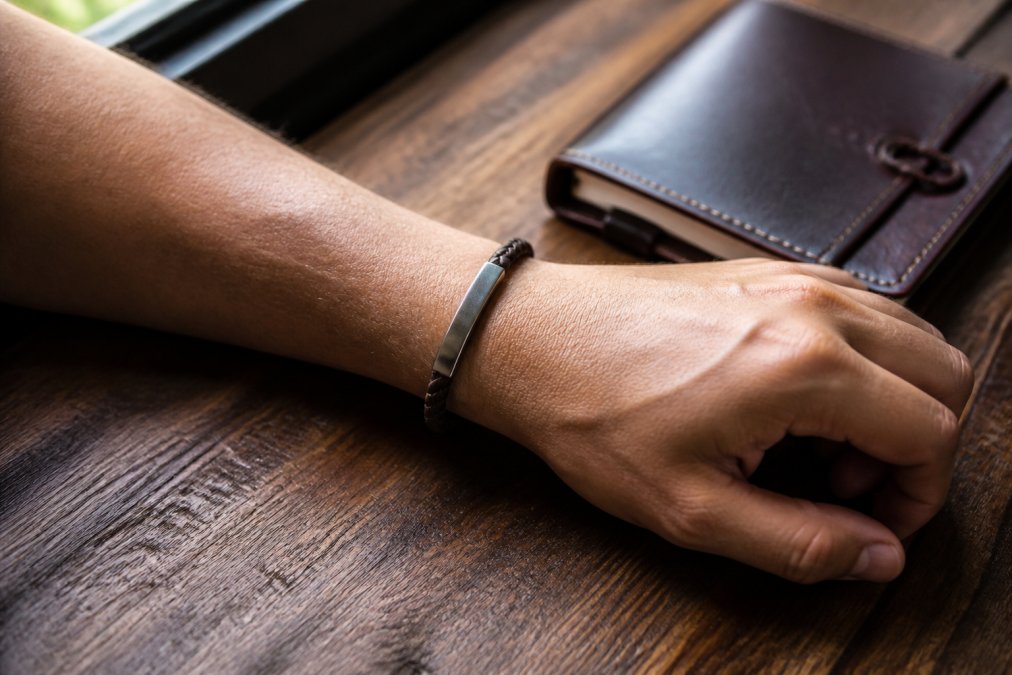
| Brown Braided Leather Bracelet | $52.00 | Leather, 316L steel bar | Business casual, layering |
| Black Braided Leather Bracelet | $52.00 | Leather, 316L steel bar | Everyday, formal |
What Actually Drives the Price
Four cost inputs explain nearly every price difference you will see between two pieces that look similar in a photo.

- Base metal. Solid 316L stainless steel, sterling silver, and gold-filled stock cost more per ounce than plated brass or zinc alloy. A solid steel ring can be resized, refinished, and re-polished; a plated alloy ring cannot, because every polishing pass removes plating.
- Engraving method. Hand engraving is billed by the hour because a graver removes metal one pass at a time. Laser engraving is billed by machine time, which is why a fast, shallow burn is cheap and a slow, deep burn is not. The price gap between the two is usually labor, not materials.
- Plating thickness. Gold plating is priced in microns. Decorative plating under roughly 0.5 microns is inexpensive; heavier plating that survives daily contact costs meaningfully more because it takes longer in the plating bath.
- Finishing and assembly. An oxidized antique finish, a hand-polished bevel, or a braided leather cord that has to be cut, sealed, and fitted to a steel bar all add bench time.
How to Read a Price Before You Buy
A useful rule of thumb: if two pieces share the same design but one costs a third as much, the difference is almost always the base metal or the plating thickness, not the design. Ask the seller three questions before you pay.
- What is the base metal under the finish?
- Is the engraving cut into the metal or burned onto the surface?
- If the piece is plated, how thick is the plating in microns?
A seller who answers all three specifically is pricing real materials. A seller who answers only the first is usually pricing the finish.
U.S. Federal Trade Commission guidance on jewelry advertising claims sets the rules sellers must follow when labeling metal content, so a "gold-tone" or "stainless steel" claim is regulated, not marketing language. That matters at checkout: a "gold-tone" label is a color description, not a statement about gold content, and a "stainless steel" label should mean the base metal is steel rather than a plated alloy core.
Durability, Wear-Over-Time, and Ethical Sourcing
Durability over time separates a keepsake from a disposable accessory, and most buying guides skip the part that matters: what actually happens to a piece after a year of daily wear. Three factors decide how a piece ages, base metal, engraving depth, and how the finish is applied, and each one fails in a predictable way.
How Different Metals Age Under Daily Wear
A common pattern across worn jewelry is that failures cluster by metal type, not by design.
- Solid 316L stainless steel. Resists tarnish, rust, and corrosion, and it will not turn skin green the way plated brass does. Engraving stays crisp because the metal is hard and the cut walls do not round over quickly. This is the metal to choose if the piece will be worn in the shower, at the gym, or at a job that involves hand contact.
- Sterling silver. Cuts beautifully and holds fine detail, but it is soft and it oxidizes. A silver ring worn daily will show surface scratches within months and darken in the recesses of the engraving, which can actually improve contrast on an antique finish but muddies a bright polish. It rewards occasional wear and periodic polishing.
- Gold-filled. A bonded layer of gold over a brass core, measured in microns of gold rather than plating thickness. It wears far longer than plating, but engraving that cuts through the gold layer exposes base metal at the bottom of the groove, where it can darken over time.
- Plated brass and zinc alloy. The cheapest option and the shortest lifespan. Thin plating wears through at the high points first, the edges of a ring, the raised face of a signet, leaving a brass core that can leave a green mark on skin.
What Wear-Over-Time Testing Actually Looks Like
You do not need a lab to predict how a piece will age. Three simple checks approximate years of wear in a few minutes.
- The fingernail test. Run a fingernail across the engraving. A distinct groove means the mark was cut into the metal. A mark you can barely feel was burned onto the surface and will blur first.
- The edge check. Look at the highest points of the piece, the rim of a ring, the outer face of a pendant. That is where plating fails first. If the finish already looks thin or uneven there, it will wear through quickly.
- The recess check. On an oxidized or antique finish, the darkening should sit in the recesses of the engraving so the detail reads clearly. If the darkening is on the raised surfaces instead, the finish was applied unevenly and will look patchy as it wears.
An oxidized antique finish is worth calling out because it is often mistaken for tarnish. Done correctly, it sinks into the recesses of an engraving so the detail reads clearly instead of vanishing into shine, and it hides the small scratches that accumulate on any worn piece.
Ethical Sourcing: What You Can Actually Verify
Ethical sourcing is the harder question to answer, because "sustainable" has no single legal definition for jewelry. That means the word alone tells you nothing. What you can verify is whether a maker can name their metal supplier and point to a third-party certification.
Responsible Jewellery Council standards for supply chain certification provides one of the few third-party frameworks that audits metal sourcing and labor practices across the supply chain. Certification is not the only signal, but it is a checkable one. When a maker can name their supplier and their certification, that is a stronger signal than a vague eco claim, and when they cannot, the honest answer is that the sourcing is unknown, not that it is clean.
For buyers who care about this, the practical move is to ask directly: where does the metal come from, and is the supplier certified? A maker who answers specifically is almost always working with better stock than one who deflects.
Conclusion
Judging the quality of custom engraved jewelry takes minutes once you know what to check: engraving depth, base metal, plating thickness, and finish. Most disappointing pieces fail on one of those four, not on design.
LodMud builds pieces around solid materials and durable engraving, from the Nano Faith line's sealed nano-engraved Biblical text to Lord Jacob's 316L steel rings and leather bracelets. Free shipping, secure payment, and responsive customer support make it straightforward to order a piece. Browse the LodMud collection and choose a piece built to keep its detail.
Frequently Asked Questions
How can you tell if engraved jewelry is high quality?
Look at the engraving depth first. Run a fingernail across the cut: if it catches, the detail will survive years of wear; if it feels smooth, it was surface-etched and will soften. Then check the metal. Solid 316L stainless steel, sterling silver, and gold-filled pieces hold detail far longer than zinc alloy or thin plating. Ask for the metal purity and whether the finish is oxidized or polished. On the LodMud Vintage Floral Engraved Skull Ring, the oxidized finish sinks into the recesses so the floral scrollwork stays readable instead of disappearing into shine.
What is the difference between laser engraving and hand engraving?
Hand engraving uses a graver to cut metal, removing material and leaving a V-shaped groove with real depth. Laser engraving burns or ablates the surface, which is faster and more precise for tiny text but typically shallower. For nano engraved Bible verse jewelry, laser is the only method that can render microscopic scripture legibly. The trade-off is depth: laser detail can fade on soft metals, which is why the base metal matters. Solid 316L steel keeps laser detail crisp; plated or alloy bases go soft within a year.
What metals are best for long-lasting engraved jewelry?
Solid 316L stainless steel, sterling silver, and 14k or 18k gold hold engraving best. Stainless steel resists tarnish, rust, and corrosion, and it will not turn skin green, which makes it a strong choice for everyday wear and for people with sensitive skin. Sterling silver is softer and patinas, so detail softens faster. Gold-filled and gold-plated pieces depend entirely on plating thickness: thin plating wears through at high-contact points. Avoid zinc alloy and pewter, which tarnish quickly and lose engraved detail within about a year.
Does custom engraving affect the durability of a ring?
Engraving removes or displaces metal, so a deep cut does create a thinner wall at that point. On a solid 316L stainless steel band, the effect is negligible for normal wear. The bigger risk is on plated or hollow pieces, where engraving can cut through the plating and expose the base metal to oxidation. If you plan to wear a custom engraved ring daily, choose a solid metal band and keep the engraving on the outer face or a wide interior surface rather than a thin edge.
How do I care for custom engraved jewelry so the detail lasts?
Clean with warm water, a drop of mild dish soap, and a soft toothbrush, then dry fully with a lint-free cloth. Avoid chlorine, harsh cleaners, and abrasive polishes, which round off engraving edges over time. Remove rings and bracelets before heavy lifting, gardening, or gym sessions where metal grinds against metal. Store pieces separately in a dry pouch so they do not scratch each other. Oxidized finishes need the least intervention: the dark recesses are intentional, so do not scrub them bright.