Men's Designer Rings: 2026 Review & Buying Guide

Table of Contents
- What Separates a Designer Ring From a Cheap One
- Men's Designer Rings Compared: Quick Reference
- Durable Materials for Men's Jewelry: What Actually Lasts
- Men's Ring Sizing Guide: Getting the Fit Right the First Time
- How to Style Men's Rings for Work, Weekends, and Weddings
- Ethical Sourcing and Long-Term Value in Men's Designer Rings
- Frequently Asked Questions
Last Updated: September 14, 2026
What Separates a Designer Ring From a Cheap One
Mens designer rings are built from solid, specified materials with intentional design, not a mass-produced casting in plated base metal.
At LodMud, we build men's designer rings around solid 316L stainless steel, which resists tarnish, rust, and corrosion without plating that wears thin. Cheap rings cut costs in the alloy: soft zinc castings pit within a year, and plated finishes flake where your hand flexes most.
Design intent matters just as much. A designer piece has a deliberate silhouette: a signet face that sits up off the finger, a faceted band with flat planes that catch light separately, a skull sculpted in the round rather than stamped flat.
Men's Designer Rings Compared: Quick Reference
Every style in this guide, mapped to its best use.
| Style | Signature Piece | Price | Best For |
|---|---|---|---|
| Signet and heraldic | Heraldic Lion Signet Ring | $32.00 | Everyday wear, heritage look |
| Skull and statement | Polished Skull Ring | $29.00 | Streetwear, bold self-expression |
| Band and faith | Cross Cutout Band Ring | $32.00 | Discreet daily faith, work settings |
| Minimalist | Roman Numeral Faceted Band Ring | $25.00 | Stacking, gifting, unisex wear |
Prices reflect LodMud's current catalog. Every piece is a one-time purchase with no subscription or hidden add-ons.

Signet Rings and Heraldic Styles
The signet is the oldest form of men's designer ring and still reads as the most serious. Once used to press a family seal into wax, it now signals heritage, but proportions still matter: a proper signet face sits up off the finger with real weight behind it.
The Lion Signet Ring puts a lion's face on a round signet, mane framing the head, with red crystal eyes set into the steel, wearable at a desk without looking costume-like.
For something closer to a coat of arms, the Heraldic Lion Signet Ring uses a rampant lion, long a heraldic symbol of courage and nobility, against a fine beaded field with a raised rim. Both are solid 316L stainless steel with a polished silver-tone finish, so there is no plating to wear through.

Skull and Statement Rings
Skull rings live or die on sculpting quality. Stamped-flat designs look like decals; a skull shaped fully in the round catches light across every curve.
The Polished Skull Ring is the cleanest expression of that idea: rounded cranium, hollowed eye sockets, defined grin, high-polish steel, no clutter. Most skull rings in this price band are cast in soft zinc alloy that pits within a year; this one is solid steel.

For the same silhouette with more shine, the Rose Gold Crystal Skull Ring sets a sculpted skull in crystal pavé over warm rose gold, bolder and more glamorous, equally good for a night out or a Day of the Dead celebration.
Bands, Crosses, and Faith Designs
Faith rings work best when the symbol is designed rather than applied. A cross stamped onto a flat band looks like an afterthought. A cross cut through the metal becomes part of the ring's structure.
The Cross Cutout Band Ring cuts a row of crosses clean through a wide band of solid 316L stainless steel. Light passes behind each one, so the shape reads sharp from any angle, and the openwork keeps a wide band comfortable, faith worn openly but without weight.
For a quieter daily piece, the Roman Numeral Faceted Band Ring skips religious iconography entirely. Numerals are cut into a faceted octagonal band, each on its own flat plane so light hits them separately, genuinely unisex and an easy gift when you are unsure of someone's taste.
Durable Materials for Men's Jewelry: What Actually Lasts
Solid 316L stainless steel is the most durable material in the men's jewelry price range and the only one worth buying for daily wear (pubmed.ncbi.nlm.nih.gov). It resists tarnish, rust, and corrosion, holds a polish, and will not turn your skin green.
The hierarchy is straightforward. Solid steel tops the list for everyday durability. Ion-plated steel comes next: the core is tough, but the colored surface layer needs care. Sterling silver tarnishes and is soft enough that intricate detail wears smooth (Silver: A metal that shows its mettle). Gold is heirloom quality but far softer, which is why 18k gold bands scratch and dent more readily than steel.
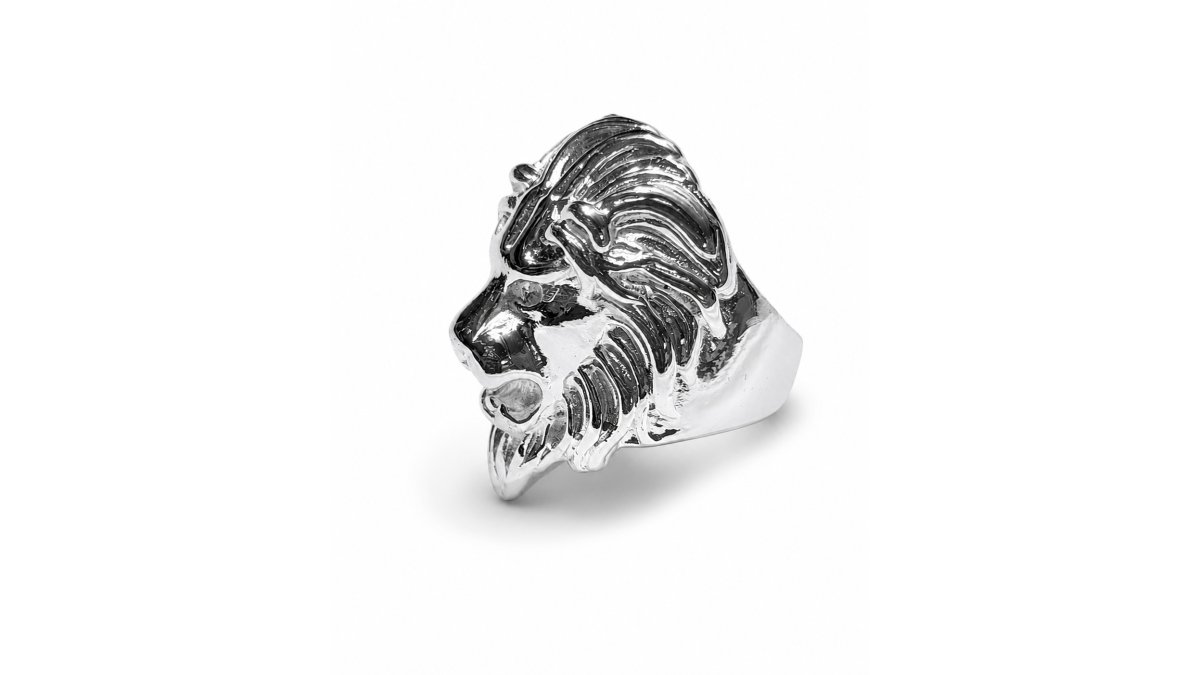
What most buyers miss is that the failure point is almost never the metal you can see, it is the plating, the setting, or the alloy underneath. A ring with no plating and no set stones has nothing to fail. That is the argument for solid steel pieces like the Majestic Lion Head Stainless Steel Statement Ring, a fully sculpted three-dimensional lion head in 316L steel with a scratch-resistant finish.
Men's Ring Sizing Guide: Getting the Fit Right the First Time
The most reliable way to size a men's ring is to measure the inside diameter of a ring that already fits, convert it using the brand's own chart, and do it at the end of the day when your fingers are largest. Most online sizing errors come from timing and band width, not measurement skill.
Why timing matters
Fingers swell through the day, in heat, and after exercise. Many people differ by roughly a half size between morning and late afternoon, enough to turn a comfortable ring into one you want off by lunch (pubmed.ncbi.nlm.nih.gov).
Measure at the end of the day, after your hands have been at normal temperature for a while. Avoid measuring right after a workout, a hot shower, or cold air conditioning, all of which distort the reading.
Two ways to measure at home
Method 1: Measure a ring you already own.
- Take a ring that fits the intended finger well.
- Place it on a flat surface and measure the inside diameter in millimeters with a ruler or calipers.
- Match that millimeter figure against the brand's sizing chart.
This is the most accurate home method because it removes the guesswork of wrapping something around your finger.
Method 2: Measure your finger directly.
- Wrap a strip of paper or a piece of non-stretchy string around the base of the finger.
- Mark where the end meets.
- Lay it flat and measure the length in millimeters, that is your finger circumference.
- Convert circumference to size using the brand's chart.
String stretches, so paper is more reliable. Measure at the base of the finger, below the knuckle, and make sure the strip slides over the knuckle comfortably, if it does not, the ring will not either.
Band width changes the fit
This is the part most sizing guides skip. A wide band covers more of the finger and fits tighter than a narrow band at the same nominal size. A domed cigar band such as the Rose Gold Dome Cigar Band Ring needs slightly more room than a thin band in the same size number.
As a rule of thumb:
- Bands under 4 mm: size as measured.
- Bands 4-7 mm: size as measured, or up a half size if you are between sizes.
- Bands over 7 mm: size up a half size, especially if you have prominent knuckles.
Comfort-fit interiors explained
A comfort-fit interior is rounded on the inside edge rather than flat, so the band glides over the knuckle instead of catching. The practical effect: a comfort-fit band tolerates a half-size error far better than a flat-interior band.
If you are between sizes and the ring has a comfort-fit interior, sizing down is usually safer for a narrow band, and sizing up is safer for a wide band.
A practical sizing checklist
- Measure at the end of the day, not first thing in the morning
- Measure the inside diameter of a ring that already fits well, in millimeters
- Compare against the brand's own sizing chart, not a generic one
- If you are between sizes, size up for wide bands and down for narrow ones
- Remember that wide bands like cigar profiles fit tighter than thin bands at the same size
- Confirm whether the ring has a comfort-fit interior, which changes how much error it tolerates
When to resize versus exchange
If the fit is wrong, exchange rather than resize, another reason to measure carefully the first time.
How to Style Men's Rings for Work, Weekends, and Weddings
Style men's rings by matching the piece to the setting, then balancing it against your hand, your sleeve, and the rest of your outfit. A ring reads differently against a dress shirt cuff than a hoodie sleeve, so "one ring for work, two for weekends" is too blunt.
A simple framework: pick the ring first, then the count, then the hand. The ring sets the volume, the count sets the formality, the hand sets the practicality.
Work and professional settings
For an office or client-facing environment, keep the ring count to one per hand at most and choose a silhouette that sits low and reads clean from across a table. A signet or cutout band works because the detail stays within the band width rather than projecting off the finger.
The Vintage Anchor Stainless Steel Signet Ring is a good example: a detailed anchor emblem framed by an engraved rope border, with openwork scroll detailing along the shoulders. It has character without shouting, and the polished steel tone sits naturally next to a stainless watch case or silver-tone belt buckle.
Two practical rules for the office:
- If you shake hands often, wear the ring on your non-dominant hand so it does not press into the other person's grip.
- Match metal tone to the hardware you already wear most days. Steel with steel, gold-tone with gold-tone. Mixing tones is a deliberate style choice, not a default.
A cuff matters here. A ring that looks proportionate on a bare wrist can look undersized peeking out from a French cuff, and a wide band can look heavy against a slim sleeve. If your daily uniform is a button-down, a moderate 6-8 mm band width tends to sit in the sweet spot.
Weekends and casual wear
Casual settings are where you can raise the volume: a sculpted statement piece worn alone, or a two-ring stack on one hand.
The Gold-Tone Engraved Skull Signet Ring is built for exactly this: a sculpted skull with ornamental engraving on a gold-tone finish, worn alone as the loudest thing on your hand. Pair it with a plain tee and denim, or a leather jacket, and let the ring carry the detail.
If you stack, keep the two rings visually related. A faceted band next to a thinner plain band works because the flat planes and smooth surface contrast without competing; two heavily sculpted rings on one finger usually fight each other. A common pattern is one bold ring on the index finger and one thinner ring on the ring finger.
Weddings and formal occasions
Formal occasions call for restraint. A plain polished band, or a signet if it has personal meaning, is the right call. Skip stacking entirely; a single well-made ring photographs better and never competes with a suit.
A few specifics that matter in formal settings:
- A high-polish finish catches flash photography better than a matte or brushed finish, which can read flat in low light.
- A ring worn on the ring finger of the left hand is the conventional wedding-band position; a signet worn on the pinky is the traditional alternative for a non-wedding formal ring.
- If you are wearing cufflinks, keep the ring metal tone consistent with them. Mixed metals in formalwear read as an oversight rather than a choice.
Matching rings to outfit palette
A quick reference for pairing ring tone with what you are wearing:
| Outfit context | Ring tone that works | Ring tone to avoid |
|---|---|---|
| Navy or charcoal suit | Silver-tone steel, white gold look | Warm gold-tone, unless matched to cufflinks |
| Earth tones, olive, brown | Gold-tone, rose gold-tone | Bright chrome silver |
| All black, streetwear | Any tone; high polish or matte both work | Nothing, this is the most forgiving palette |
| Business casual, light blue shirt | Silver-tone steel | Heavy sculpted statement pieces |
Hand and finger placement
Where you wear a ring changes how it reads. The index finger projects confidence and is most visible in conversation. The ring finger is the conventional band position. The pinky is the traditional signet position, reading as heritage or, in some subcultures, affiliation. The thumb is boldest and works best with a wide band.
For most men new to designer rings, the ring finger or index finger on the non-dominant hand is the lowest-risk start: visible enough to be noticed, practical enough to avoid knocking against surfaces all day.
Ethical Sourcing and Long-Term Value in Men's Designer Rings
Long-term value in mens designer rings comes from buying a piece you will still want to wear in ten years: a solid material, a timeless silhouette, and no surface finish to degrade.
Ethical sourcing here is mostly about materials you can verify. Solid stainless steel is recyclable and does not depend on plated surface chemistry. For crystals or stones, ask where they come from and whether the setting is secure; for gold or silver, ask about the alloy and its origin.
Heirloom quality is a real category, and it is not the same as expensive. A ring earns that label by surviving daily wear with its detail intact. Soft cast alloys lose their crispness; solid steel does not. Engraving cut into solid metal stays legible for decades, while engraving on plating disappears with the plating.
That is the practical case for buying fewer, better rings: a $25 piece worn daily for a decade costs less per wear than three $15 rings that pit and get replaced. For faith kept close in a form that lasts, LodMud's Nano Faith range pairs meaningful content with the same material discipline, and every order ships free with secure payment and responsive support if the fit is not right.
Choosing men's designer rings comes down to three decisions: solid material over plating, a silhouette that matches how you actually dress, and a fit measured at the right time of day. Get those right and the ring stops being an accessory you manage and becomes one you forget you are wearing. LodMud builds for exactly that outcome, with solid 316L stainless steel construction across the Lord Jacob collection, nano-engraved faith pieces through Nano Faith, free shipping, secure payment, and a support team that answers when a size or a custom engraving needs sorting. Get started with LodMud and find the ring you will still be wearing in ten years.
Frequently Asked Questions
What materials are most durable for men's designer rings?
Solid 316L stainless steel is the most durable option at accessible prices. It resists tarnish, rust, and corrosion, won't turn your finger green, and holds fine detail for decades. Plated finishes (gold-tone, rose gold ion plating) look richer but are surface layers that wear over time, so remove them before showering or swimming. Sterling silver and 18k gold are classic choices but softer, meaning engraved detail smooths out faster with daily wear.
How should a men's designer ring fit?
A well-fitted ring slides over the knuckle with slight resistance and sits snug without pinching. Your fingers change size through the day and with temperature, so measure at room temperature in the late afternoon when fingers are at their largest. Wider bands like cigar bands or signets feel tighter than thin bands at the same size, so size up half a size for bands over 8mm. A comfort-fit interior, common on quality designer rings, makes a snug fit more wearable.
Are designer rings a good investment?
At the $25-$50 range, men's designer rings are better understood as durable personal pieces than financial investments. Solid stainless steel rings hold their appearance and detail for years, which gives them real long-term value compared to soft alloy rings that pit within a year. If you want something with resale potential, look at solid gold or platinum with certified gemstones. For everyday wear, a well-made steel designer ring costs less than a dinner out and lasts far longer.
How do I style multiple rings as a man?
Keep it to two or three rings maximum and vary the visual weight. A common approach: one statement ring (signet, lion head, or sculpted skull) on the index or middle finger, plus a thinner band on the ring finger or pinky. Match metals within a hand (all silver-tone or all gold-tone) so the look reads intentional. Stack thin bands on one finger if you want more presence without spreading rings across every hand.
What are the current trends in men's designer rings?
Signet rings with heraldic or animal motifs remain the dominant style, followed by sculpted skull rings in polished steel and rose gold. Textured and intricate finishes, faceted bands, and openwork designs are gaining ground over plain bands. Faith-inspired pieces, particularly cross cutout bands and engraved designs, are growing as men look for jewelry with personal meaning. Rose gold and warm-tone finishes continue to expand beyond traditional silver and yellow gold.