How to Choose Christian Jewelry: A 2026 Guide

Table of Contents
- Why the Right Christian Jewelry Matters
- Symbolism in Christian Jewelry: Matching Meaning to Wearer
- Durable Christian Jewelry Materials: What Lasts
- Choosing a Style: From Discreet to Statement
- Mens Designer Rings: A Faith Statement for Him
- How to Choose Christian Jewelry for Gifting
- Caring for Your Christian Jewelry
- Making Your Final Choice
- Frequently Asked Questions
Last Updated: September 5, 2026
Christian jewelry is a deeply personal expression of faith, yet most shoppers choose pieces based on appearance alone without considering how symbolism, material, and design align with daily life. This guide from LodMud walks through the practical decisions behind selecting meaningful pieces, from understanding religious iconography to evaluating durable materials.
Why the Right Christian Jewelry Matters
The right piece of christian jewelry does more than accessorize an outfit; it anchors a personal conviction that travels with you through professional meetings, daily routines, and quiet moments of reflection. Many buyers discover that a hastily chosen necklace or ring ends up in a drawer because it clashed with their wardrobe or felt flashy.
A thoughtful selection considers three layers: the symbol's theological meaning, the material's ability to withstand your lifestyle, and the design's fit with your personal aesthetic. Getting all three right produces a piece you never want to take off.
Symbolism in Christian Jewelry: Matching Meaning to Wearer
Symbolism in christian jewelry carries centuries of theological weight, so the icon you select should reflect how the wearer understands and practices their faith.
Cross vs. Crucifix vs. Ichthys
The plain cross emphasizes the resurrection and victory over death, making it the most versatile choice for Protestants and those who prefer understated expressions. The crucifix, bearing the body of Christ, centers on the sacrifice itself and is most common in Catholic and Orthodox traditions. The ichthys, or fish symbol, traces back to early Christians who used it as a secret sign of recognition during persecution.
For a corporate environment where faith must remain private, a simple cross pendant reads as elegant jewelry first. For someone who wants an explicit theological statement, the crucifix leaves no ambiguity about denominational identity.
Less Common Symbols and Their Stories
Beyond the familiar icons, several symbols carry rich narratives that resonate with specific wearers. The mustard seed pendant references the Gospel passage about faith moving mountains, a fitting gift for someone facing a major life transition. The miraculous medal, originating from an 1834 apparition in Paris, appeals to those with strong Marian devotion. St. Christopher medals, traditionally worn by travelers, suit someone who spends significant time on the road.
Durable Christian Jewelry Materials: What Lasts
Durable christian jewelry materials determine whether a meaningful gift survives daily wear or becomes a fragile keepsake. The metal you choose affects longevity, maintenance, and how the piece interacts with your skin chemistry.
The Daily-Wear Trade-Off: Plated vs. Vermeil vs. Solid
The single biggest mistake shoppers make is confusing "gold-plated" with "gold-filled." They are not the same, and the difference determines whether a piece lasts six months or six decades.
Gold-plated jewelry has a microscopic layer of gold, often 0.5 microns or less, bonded to a base metal. It is inexpensive and looks fine in a display case, but friction, handwashing, and sweat erode that layer quickly. Once the base metal (often brass or copper) is exposed, it reacts with skin and causes discoloration many mistake for an allergy.
Gold-filled is a different construction entirely. A thick layer of solid gold, typically 5% of the item's total weight, or about 100 times more gold than standard plating, is mechanically bonded to a jeweler's brass core under heat and pressure. This is not a coating that flakes off; it is a metallurgical bond. Gold-filled pieces survive daily wear for decades, tolerate soap and water, and only require occasional polishing. The price sits between plated and solid gold, making it the value sweet spot for everyday religious jewelry.
Vermeil is the confusing middle child. By Federal Trade Commission definition, it must have a base of sterling silver coated with at least 1.5 microns of gold (the FTC). It looks brighter and more luxurious than gold-filled because of the silver base's luster, but 1.5 microns is still thin. Vermeil requires care: remove it before swimming, showering, or working out. For occasional wear, a Sunday service, a dinner out, it is beautiful; for a 24/7 faith piece, it will disappoint.
Solid gold (10k, 14k, 18k) remains the heirloom standard. 10k gold is 41.7% gold alloyed for hardness, it scratches less but can cause reactions in sensitive individuals. 14k gold is 58.3% gold and the most common daily-wear choice in the U.S. because it balances purity with durability. 18k gold is 75% gold, softer and more prone to scratching, but ideal for very sensitive skin. Solid gold never tarnishes or wears through, but costs 10 to 20 times more than gold-filled for the same design.
The Allergy Question: What "Hypoallergenic" Actually Means
The term "hypoallergenic" has no legal definition under U.S. law; the Federal Trade Commission does not regulate its use on jewelry labels (the FDA). The practical approach is to look at the specific metal composition rather than trust marketing language.
Nickel is the most common contact allergen in jewelry, affecting an estimated 10% to 20% of the U.S. population (peer-reviewed research). It is frequently used as a hardener in lower-quality gold alloys and stainless steel. The exception is 316L surgical stainless steel, which is specifically formulated to be nickel-free and is the same material used in medical implants and body piercings.
Sterling silver (92.5% silver, 7.5% copper) is safe for most wearers, but the copper can cause reactions in a small subset. Fine silver (99.9% pure) eliminates that issue but is too soft for daily-wear rings or clasps. For confirmed metal allergies, 14k solid gold or platinum are the only guaranteed safe options.
A Practical Decision Framework
Instead of asking "which metal is best," ask "how will this piece be worn?" Use this framework:
- 24/7 wear, including showers and workouts: 316L stainless steel or 14k solid gold. Both handle constant exposure to water and soap.
- Daily wear, removed for sleep and exercise: Gold-filled. It tolerates daily use but benefits from being dry at night.
- Occasional wear, special occasions: Vermeil or 10k gold. Both look premium without the solid-gold investment.
- Heirloom piece meant to be passed down: 14k or 18k solid gold. The cost is justified by the multi-generational lifespan.
This framework is the angle most competitor guides miss. They list metals but never connect material choice to actual wearing habits.
Choosing a Style: From Discreet to Statement
Your personal style determines whether a faith-based piece integrates seamlessly into your wardrobe or stands out as a deliberate focal point. For professionals who keep faith private, delicate chains with small pendants offer daily wear without drawing attention.
But "style" is not a single decision, it is a set of choices about chain length, pendant scale, metal finish, and how the piece interacts with your wardrobe.
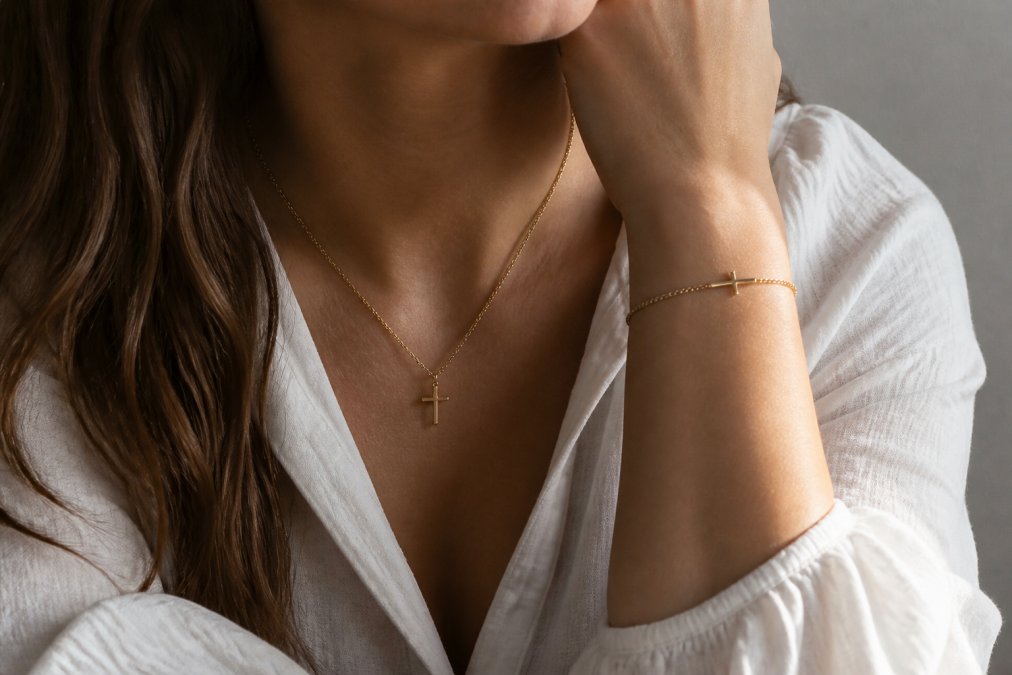
Chain Length and Pendant Scale: The Invisible Style Decision
Chain length determines whether a cross sits at the collarbone, sternum, or below the chest, each position sends a different signal. A 16-inch chain rests at the base of the neck, keeping a pendant visible above most necklines. An 18-inch chain, the most common U.S. length, sits at the collarbone and works with crew necks and V-necks. A 20-inch chain drops to the sternum, allowing the pendant to hide under an open-collar shirt.
Pendant scale matters just as much. A pendant smaller than 12 millimeters reads as a subtle accent for boardrooms and formal events. Between 12 and 18 millimeters it becomes a visible statement of faith.
Layering Rules That Actually Work
Jewelry layering has become a mainstream styling technique that naturally accommodates faith-based pieces. But layering fails when pieces tangle or compete for attention. Three practical rules prevent that:
- Vary chain lengths by at least 2 inches. A 16-inch chain layered with an 18-inch chain will tangle. A 16-inch with a 20-inch stays separated.
- Mix one religious piece with secular pieces. A small cross pendant layered with a plain bar necklace or a birthstone charm reads as intentional style, not a uniform. Layering three crosses looks costume-like.
- Match metal tones. Mixing yellow gold with white gold or silver can work in high-fashion contexts, but for everyday wear, keeping all layers in the same metal family creates a cohesive look.
Occasion-Specific Styling
Corporate or professional settings: Choose a pendant under 14 millimeters on an 18-inch chain. Tuck it under a collared shirt or blouse when discretion is required. A brushed finish reflects less light and draws less attention than a high-polish finish.
Formal events (weddings, galas, milestone celebrations): A single, high-quality piece, a delicate gold cross on a fine chain or a signet-style ring with an engraved symbol, complements formal attire. Avoid layering at formal events; the aesthetic is restraint.
Casual and weekend wear: This is where bolder expressions fit. A substantial pendant on a leather cord, a chunky stainless steel ring, or a visible ichthys bracelet works naturally with denim and casual layers.
Athletic and active lifestyles: Skip pendants entirely. A 316L stainless steel ring or a silicone-embedded faith bracelet survives workouts, swimming, and yard work without catching on equipment or tarnishing from sweat.
Men's Styling: Substance Over Ornament
Men's religious jewelry fails when it mimics the scale and delicacy of women's pieces. The solution is not a bigger cross, it is a different category of jewelry altogether. Rings and bracelets in darker metals (brushed steel, black ion-plated finishes) integrate naturally into masculine aesthetics. A signet-style ring with a subtle cross engraving reads as a family heirloom or a class ring until the wearer chooses to explain it.
For men who wear suits regularly, a pocket cross, a small cross kept in a pocket rather than worn visibly, offers a private devotional practice that never conflicts with professional dress codes.
Mens Designer Rings: A Faith Statement for Him
Mens designer rings offer men a way to carry their faith that feels masculine and intentional rather than ornamental. Many men avoid religious jewelry because delicate pieces feel mismatched with their lifestyle.
The Lord Jacob collection within LodMud addresses this gap with bold, refined pieces built for daily wear. The Lord's Prayer ring, crafted from 316L stainless steel, provides a discreet yet meaningful option that survives manual work, workouts, and frequent handwashing without losing its engraved text. For men who have tried prayer bead bracelets that frayed or snapped within weeks, a solid metal ring eliminates that durability concern entirely.

How to Choose Christian Jewelry for Gifting
Gifting christian jewelry requires understanding the recipient's spiritual journey and the significance of the occasion. A baptism piece carries different expectations than one for a graduation or anniversary.
Baptisms, Confirmations, and Milestones
For baptisms and confirmations, select pieces that can grow with the recipient. Infants will eventually wear baptism gifts as children, so choose durable materials and classic designs. Confirmations, typically in the early teens, warrant pieces that respect the young person's emerging style rather than imposing adult tastes.
Budget vs. Longevity
A common mistake is prioritizing upfront cost over endurance. An inexpensive find may tarnish within months, requiring replacement and ultimately costing more than a quality piece purchased once. Budget-conscious shoppers should consider stainless steel and gold-filled options.
Caring for Your Christian Jewelry
Proper jewelry care extends the life of faith-based pieces significantly, preserving appearance and the legibility of engravings.
For stainless steel, warm water and mild soap with a soft cloth handles most cleaning needs. Gold-filled and vermeil require gentler treatment, avoiding abrasive cleaners that strip the gold layer. Remove jewelry before swimming in chlorinated pools and store pieces separately to prevent scratching.
Making Your Final Choice
Choosing christian jewelry ultimately comes down to honesty about how the piece will be worn. A delicate gold cross pendant from Nano Faith, such as the Imperial Pave with its embedded Bible chip, suits someone who wants elegance with hidden meaning. The Rose Gold Art Deco Cross offers a fashion-forward option for those who want style first.

Nano-engraved pieces from LodMud add intimacy through microscopic chips engraved with sacred Biblical text, carrying specific verses close to the wearer at all times. The right piece becomes more than an accessory; it becomes a daily anchor for faith, chosen deliberately and worn with intention.
Frequently Asked Questions
What is the best Christian jewelry brand?
The best brand depends on your priorities. Look for a company that is transparent about its materials, offers a clear warranty, and designs pieces that fit your personal style. For example, LodMud's Nano Faith collection combines classic designs with nano-engraved Bible chips, offering a discreet and durable way to carry scripture. Read reviews about the quality and customer service before you buy.
How do I choose between gold and silver for faith-based jewelry?
Your choice should be based on your skin tone, wardrobe, and maintenance preferences. Sterling silver is a bright, versatile choice that suits most people and is easy to care for. Gold-filled or vermeil options offer a warmer tone and are more tarnish-resistant than silver for daily wear. If you have sensitive skin, look for hypoallergenic options like stainless steel or solid gold.
Is it appropriate to wear Christian jewelry as a daily accessory?
Yes, many people wear Christian jewelry every day as a personal reminder of their faith. The key is choosing a design that fits your lifestyle. If you work in a formal environment, a discreet cross pendant or a plain band ring might be more suitable than a large, ornate piece. Durable materials like stainless steel or gold-filled are best for pieces you plan to wear constantly.
How can I ensure the quality of my Christian jewelry?
Check the material specifications. Look for terms like '316L stainless steel' for rings or 'gold-filled' for necklaces, which are known for durability. Ask about the thickness of any plating. For pieces with engravings, ask how the engraving is applied and whether it is covered by a warranty. A reputable seller will be happy to explain their craftsmanship and materials.
What should I look for when buying Christian jewelry as a gift?
Consider the recipient's personal style and the occasion. For a baptism, a classic cross pendant is a timeless choice. For a confirmation or graduation, a piece with a specific saint or a scripture-engraved chip can feel more personal. Pay attention to their metal preferences and whether they have allergies. A thoughtful gift shows you considered their taste, not just the symbolism.
What is the significance of wearing Christian jewelry?
For many, it serves as a public declaration of faith and a private reminder of their beliefs. It can be a source of comfort and strength throughout the day. Symbols like the cross remind wearers of Christ's sacrifice, while other symbols like the anchor represent hope. The jewelry acts as a tangible connection to one's spiritual life and heritage.
Selecting faith-based jewelry should honor both the belief it represents and the person who wears it. LodMud combines Nano Faith's meaningful nano-engraved Biblical content with Lord Jacob's bold masculine designs, offering options that respect your style, your skin, and your budget. Explore the collection and find a piece that will stay with you through every season of life.
This article was written using GrandRanker